
Featured Content
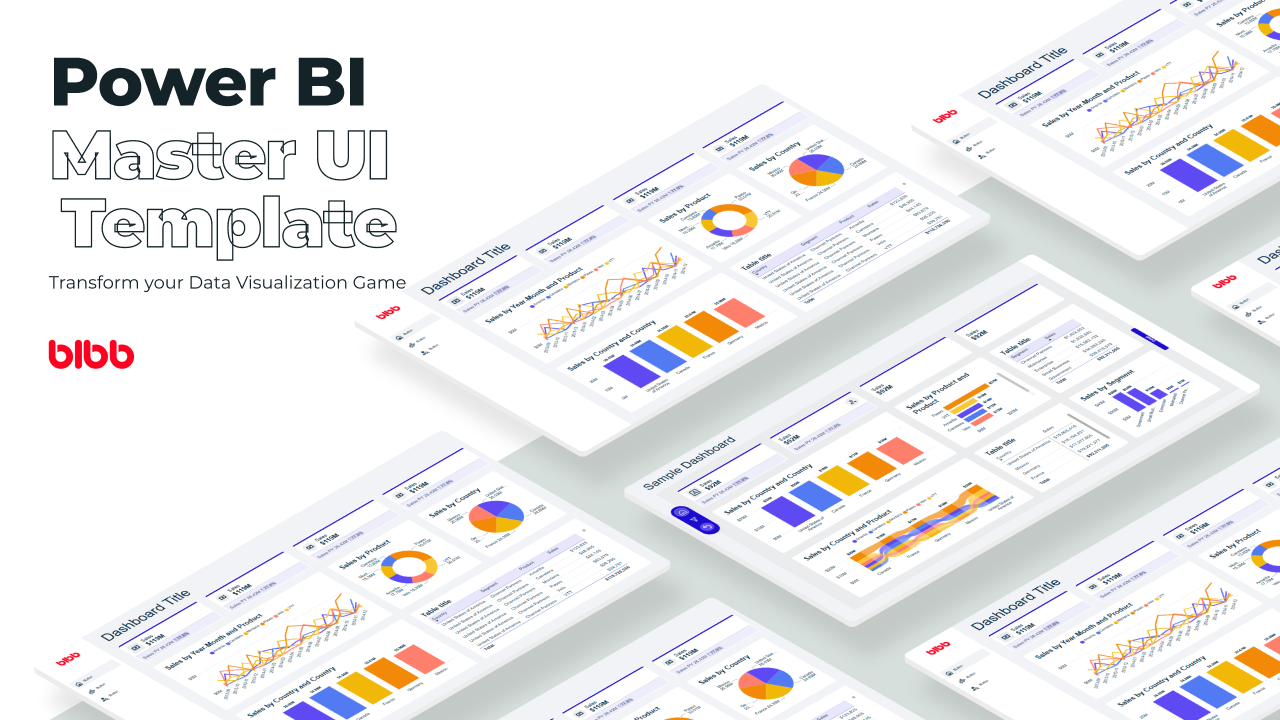
Power BI Master UI Template
Develop Data Visualization 80 % Faster - 4 Premium Templates · 7,000 Icons · 100% Theme Generator compatible
Salesforce Power BI Integration: A Practical Comparison Guide
Salesforce Power BI integration done right: compare native connectors, custom API, and the Metrica connector to choose the best approach for your team.

How to Design Better KPIs Before They Mislead You
How to design better KPIs starts with knowing what your formula isn't measuring. A real BI case study in dashboard blind spots, with DAX examples and a fix.
AI Agent Skills: Stop Paying for Tokens You Don't Need
AI agent Skills replace bloated instruction files with on-demand context loading — cutting token waste by 80% for Excel and Power Query workflows.

KPI Tree for Performance Management: A Visual 7-Step Guide
KPI Tree for Performance Management: a practical 7-step method to align strategy with KPIs, cut metric overload, and create dashboards people actually use.

DAX and UDF SVG Charts in Power BI: Complete Guide
Learn to build DAX and UDF SVG charts in Power BI with this complete guide. Create custom visualizations using pure DAX code with dynamic scaling and conditional formatting.

DAX + UDF = the React of Power BI
Learn how to combine Power BI DAX user-defined functions with HTML visuals to build reusable KPI cards, tables, and progress bars that wow report stakeholders.
Automating Power BI Themes with Fabric, Notebooks and BIBB Theme Generator API: A Complete Guide
Learn how to automate Power BI report theme updates using Microsoft Fabric, Python, and the BIBB Theme Generator API for seamless theme management.
What is a Template in Power BI? Settling the debate.
Understand what each Power BI Template type does, when to use it, and how it shapes the user experience.
Improving BI User Experience in Corporate Environments: Practical Strategies That Work
Discover actionable techniques for improving BI user experience in corporate environments, focusing on user personas, training, and documentation.
Data Exfiltration in Power Query - Understanding the Risk and Protections
Data Exfiltration in Power Query: Understanding the Risk and Protections
Why Your BI Team Needs a Product Mindset, Not Just Reports

When I look back across my career - across the organisations, sectors, and projects I’ve been involved with - one observation keeps resurfacing. Not because it’s subtle, but because it’s so visible that it’s almost uncomfortable to say out loud.
Most BI teams still behave like reporting factories.
And they think the problem is tooling.
It isn’t.
It’s the mindset that underpins how they work.

I’ve watched highly skilled engineers and analysts spend their time responding to requests, redesigning dashboards that already existed, rebuilding data models that weren’t actually broken, and jumping between competing priorities that never seem to resolve into anything coherent. None of it is malicious. All of it is logical within the boundaries of a reporting culture. But without a BI team product mindset, the cumulative effect is a function that produces output without ever building equity.
This is why so many organisations, even well-funded ones, end up in a state of perpetual reinvention. Each new change - new architecture, new cloud strategy, new BI platform - is presented as a fresh start. But the underlying behaviour remains the same. You don’t fix misalignment by replacing the tool. You fix it by changing what the team believes its job is.
A Reporting Mindset Has No Memory
A reporting mindset is inherently short-term. It starts with a request and ends with delivery. And once something is delivered, it falls into the long tail of “things we’ll get round to reviewing if someone complains.”
Over time, those tails become entire forests of dashboards and datasets that no one fully owns, understands, or maintains. Executives look at this sprawl and conclude the team is too slow. BI teams look at the incoming requests and conclude the business doesn’t know what it wants. Both views are correct in their own way, but both miss the deeper issue:
No one is stewarding the long-term purpose of the work.
How to Surface the Reality: A BI Audit Checklist
Before teams can shift their operating model, they need to understand the state they’re actually in. A simple first step is to surface the underlying reality:
- Identify dashboards with no named owner - Who is responsible for maintaining and evolving each report?
- Review assets that haven’t been refreshed, redesigned, or revisited in over 12 months - Are they still relevant?
- Map where definitions have drifted across reports - Do different dashboards calculate the same metric differently?
- Highlight redundant dashboards tackling the same decision from slightly different angles - Can these be consolidated?
Most BI leaders already suspect the answers. Seeing them clearly forces the conversation that follows.
This isn’t unique to any single organisation. Harvard Business Review reported in 2022 that only 39% of executives believe their organisations manage data as an asset, and barely 24% consider their companies to be genuinely data-driven. That gap shows up most clearly after launch: analytics solutions don’t fail because the insight stops being relevant, but because no one is accountable for maintaining, refreshing, and evolving them as the business context shifts.
I’ve seen dashboards that were transformative in year one and irrelevant by year three, not because the decision changed, but because the context around it did. New metrics appeared. New policies emerged. Data definitions drifted. And in the absence of ownership, the experience fractured quietly and continuously.
How a Product Mindset Transforms BI Teams
A product mindset introduces two disciplines that BI traditionally avoids: intentionality and continuity.
A BI team product mindset introduces intentionality—stopping reactive work patterns and starting to articulate what problems actually matter, why they matter, and how the work aligns to them. It changes the conversation from “What do you want me to build?” to “What decision are you trying to improve, and what would better information enable?”
Continuity means the work does not end at delivery. It matures. Insights evolve. The team actively looks at usage patterns, questions whether the design is still appropriate, and adapts the product based on how the organisation changes around it.
Neither of these behaviours are natural to teams measured by delivery volume or sprint throughput. But both are essential if BI teams want to create compounding value instead of disposable artefacts.
Operational Changes to Build Momentum
For teams trying to make the shift, small operational changes help create momentum:
- Frame new requests around the decision, not the visual - What business outcome needs to improve?
- Create a lightweight usage review cycle - Quarterly is enough to start
- Define minimum lifecycle expectations for every dataset and report - Who owns it? When should it be reviewed?
- Capture assumptions and definitions up front - Document them so they don’t erode quietly over time
None of this is complex. It’s simply unfamiliar.
Why BI Teams Struggle Without a Product Mindset
 Where BI Lost Its Direction
If you trace back the history of BI inside most organisations, you see how it drifted into this reactive posture.
BI began as a reporting service - literally. Its purpose was to produce reports that mirrored existing operational processes. When analytics became more sophisticated, the service layer grew but the underlying identity didn’t evolve. Even today, many BI functions see themselves as service desks for information.
The problem is that the business has moved on. Decision-making has moved on. The complexity of the data landscape has moved on.
But BI’s internal operating model is still anchored in 1990s expectations: gather requirements, build a report, deliver it, move on.
This is why organisations end up with parallel dashboards showing different numbers, conflicting versions of the truth, inconsistent calculation logic, and data models that appear and disappear with each project cycle.
There is no product lens to bring coherence. No one thinking about lifecycle. No one designing for long-term use.
Just activity. Lots of it.
Building a BI Team Product Mindset: The Strategic Opportunity
Developing a BI team product mindset is not about adopting the rituals of software teams. It’s about elevating the discipline itself and treating information as a strategic product.
At its core, a product mindset does something very simple: it asks BI to stop treating information as a deliverable and start treating it as an experience.
That shift has profound implications.
It means that when someone asks for a dashboard, the first question isn’t “What visuals do you want?” but “What behaviour needs to change?”
It means BI teams look at adoption metrics not to justify their existence but to understand where friction is occurring.
It means a dataset that supports 12 different reports is recognised as an asset that needs care, not a bucket that keeps growing until someone gets fed up and starts again.
Product Intake Questions for BI Teams
To operationalise this mindset, BI teams can begin by asking different questions at intake:
- What decision is this meant to influence? - Move beyond feature requests to understand the business problem
- Who uses it today, and who should use it tomorrow? - Understand your users and their evolution
- What does “good” look like? - Define success in adoption, cycle time, or quality
- What happens if we don’t build this? - Force prioritization through impact assessment
And most importantly, it means BI starts to accumulate value rather than reinvent it every few years.
There is growing evidence that organisations who approach data this way outperform those who don’t. McKinsey’s 2024 Strategy survey found that companies with product-oriented data functions were significantly more likely to demonstrate improved decision-cycle times and higher reuse of analytical assets - two indicators that strongly predict broader digital maturity.
Why This Matters More Now Than Ever
The shift toward AI has exposed a truth that many organisations have glossed over for years: without coherence, nothing scales.
AI models built on fragmented definitions, inconsistent lineage, or poorly governed sources simply amplify the inconsistency. Gartner reported in 2024 that 60% of AI projects fail to meet expectations because the underlying data environment is not trustworthy.
This is what happens when you have decades of reporting, but no product philosophy to bind it together.
The organisations that succeed with AI aren’t the ones with the most sophisticated models. They’re the ones with the cleanest, clearest, most intentionally designed data products - because those are the assets foundation models, semantic layers, and automation frameworks depend on.
A reporting mindset cannot deliver those foundations. A product mindset can.
What BI Leaders Need to Confront
If BI teams want to become strategic partners instead of request fulfilment units, they must adopt a product mindset and confront some uncomfortable truths:
- Not every request deserves to be built
- Not every dashboard should survive
- Not every dataset is a product; some are scaffolding
- Value must be evidenced, not assumed
- Ownership matters more than enthusiasm
This isn’t about maturity models or new roles or org charts. It’s about the willingness to treat information as something that requires design, intention, and stewardship - just like any other digital product.
The Quiet Shift
 Change ahead
Some organisations are already making this transition. You can see it in small signs:
- Dashboards are retired deliberately
- Models are versioned like software
- Business subject areas are treated as products with their own roadmaps
- Teams talk about experience, not visuals
And in these organisations, something interesting happens: BI stops being a cost centre and starts becoming part of how the business learns.
None of it is glamorous. None of it is fast. But once you see it, you can’t unsee it.
Making the Shift
If your BI team feels stretched, overwhelmed, or caught in a constant cycle of rebuilding, it’s worth questioning whether the problem is really capacity - or whether the team is still operating under a reporting mindset that can’t produce compounding value.
The work your team does is too important to be treated as a service function. Information shapes decisions. Decisions shape the organisation. That deserves ownership. And it deserves continuity.
Comments
Share your take or ask a question below.